- Published on
Bottle Pressure Failure Prediction System
- Authors

- Name
- Putra Zakaria Muzaki
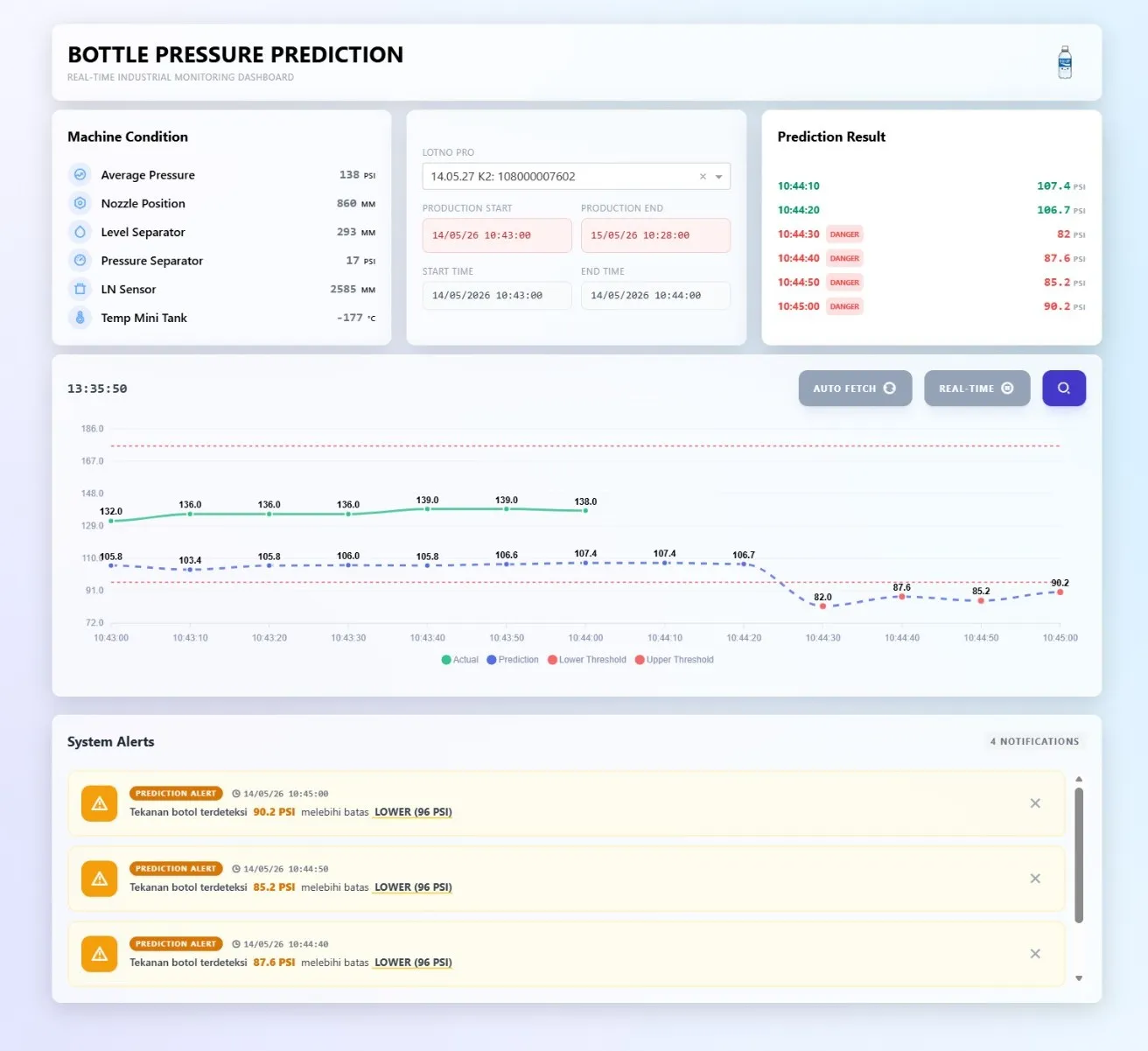
Prediction of Defective Products Due to Bottle Pressure Failure
The application analyzes historical operational data, consisting of main variables from the filling machine, to predict the average bottle pressure value on the Bottle Pressure Detector (BPD). By deploying this model, production operators receive immediate alerts before packaging failures occur, reducing material losses and improving efficiency.
Key Features
1. XGBoost Predictive Engine
The core of the prediction relies on the Extreme Gradient Boosting (XGBoost) algorithm.
- The architecture functions as a forest of small, separate decision trees where each new tree specifically acts as a learner for residual error.
- This structure actively avoids adding nodes to previous trees, focusing instead on additive strategy improvements.
- The model achieved a Mean Absolute Percentage Error (MAPE) of 2.368% under optimal hyperparameter configurations.
2. Real-Time Early Warning Dashboard
The frontend provides an interactive Single Page Application (SPA) dashboard to assist operators with monitoring.
- Machine Condition: Displays real-time operational indicators from the filling machine and BPD.
- Prediction Result: Lists the estimated average bottle pressure alongside the timestamp.
- System Alert: Automatically triggers a visual warning when predicted values cross the predefined threshold to prevent reject accumulation.
3. Comprehensive Statistical Model Validation
System evaluation strictly utilizes statistical model validation to guarantee accuracy in identifying defective bottles, actively avoiding simple functional blackbox testing.
- The model validation recorded an accuracy of 99.99% in classifying rejected products.
- The system successfully achieved a precision rate of 99.09% and a recall rate of 92.37%.
Technical Stack & Architecture
The project follows the Cross-Industry Standard Process for Data Mining (CRISP-DM) framework and utilizes a decoupled client-server architecture:
- Front-End: Angular (delivers a responsive Single Page Application for real-time monitoring and data visualization).
- Back-End: FastAPI & Python (handles data preprocessing, feature engineering, and serves RESTful API endpoints asynchronously).
- Machine Learning: Scikit-Learn & XGBoost (executes the predictive modeling using extracted
.pklmodels via the Pickle library for low-latency inference).